Overview
If you are visiting Hokkaido for the first time, put Hakodate on your map.
I know Sapporo gets a lot of attention. I know people talk about ski resorts, huge mountains, and famous seafood towns. But Hakodate has something that feels completely different.
It is a port city with a long international history, old Western-style buildings, Japanese temples, seafood markets, trams, churches, hills, hot springs, and one of Japan’s most famous night views. You can eat a bowl of fresh seafood in the morning, walk through a historic neighborhood in the afternoon, and watch the city lights sparkle between two seas at night.
That is a pretty good day.
Hakodate opened its port to international trade in the 19th century, and you can still see the results when you walk around the city. Old churches and Western-style buildings sit close to Japanese temples and traditional streets. The city does not feel like a museum, either. Trams still run through the middle of town, fishermen still bring seafood to market, and locals still use the same streets visitors come to photograph.
I especially like Hakodate because it is easy to explore without rushing.
You can spend a morning around Goryokaku, take the streetcar toward Motomachi, stop for coffee, walk down Hachiman-zaka, eat seafood near the bay, and finish the day on Mount Hakodate.
Then, when your feet are tired, you can soak in Yunokawa Onsen.
This guide is your starting point for the whole Hakodate cluster. Each place below deserves its own detailed guide, so think of this article as your main map before you decide where to go.
One more thing: Hakodate is compact compared with many major Japanese cities, but hills, winter weather, limited bus frequencies, and the city’s shape can make a simple-looking itinerary take longer than expected.
Give yourself some breathing room.
You will enjoy the city much more that way.

Top Things to Do in Hakodate
Goryokaku — A Star-Shaped Fortress With a Big Story
Goryokaku is one of the first places I would visit in Hakodate.
At ground level, it looks like a large green park surrounded by a moat. From above, the shape suddenly makes sense: a huge five-pointed star.
Goryokaku was built in the final years of the Edo period as a Western-style fortress. It later became the stage for the Battle of Hakodate, one of the final conflicts of the Boshin War. The restored Hakodate Magistrate’s Office stands inside the fort, giving visitors a chance to see part of that history up close.
The best way to understand the shape is from Goryokaku Tower. From the observation deck, the star-shaped moat spreads out below you.
Then go back down and walk.
In spring, roughly 1,500 cherry trees fill the park with pink blossoms. You can walk around the moat, enjoy the flowers, and even see locals having a seasonal barbecue in designated areas.
In summer, the park becomes green and relaxing. Autumn brings warmer colors, while winter gives the fortress a completely different look under snow.
Don’t just take the tower photo and leave.
Walk around the park afterward. The contrast between the geometric fortress and ordinary trees, water, birds, and people enjoying the park is part of the experience.
Read more: Goryokaku Fortress Guide
Mount Hakodate — The Night View You Came For
Let’s be honest.
At some point, you are probably going to look at photos of Hakodate’s night view and think, “Is it really that good?”
Yes, but the experience is about more than the photograph.
From Mount Hakodate, the city appears as a narrow strip of land between Hakodate Bay and the Tsugaru Strait. At night, thousands of lights form a bright line between the dark water on both sides.
When the weather is clear, the view can be astonishing.
The best moment is not always the darkest part of the night. I like arriving before sunset when possible. You can watch the sky change from blue to purple and then see the city lights gradually appear.
That transition gives you a much better sense of the geography.
There is one catch: everyone else knows how good the view is.
At popular times, the summit can become very crowded. Weather can also ruin the view. A cloudy evening can turn the famous panorama into a wall of gray.
So check the forecast before heading up, and don’t treat the mountain as a guaranteed photo stop.
If the conditions are poor, you can simply change your plan and come back another evening.
Read more: Mount Hakodate Night View Guide
Hakodate Morning Market — Start the Day With Seafood
Wake up early.
Seriously.
Hakodate Morning Market is one of those places where getting out of bed at 7 a.m. is actually worth it.
The market is close to Hakodate Station, making it easy to visit at the beginning of a sightseeing day. The atmosphere is lively, with seafood shops, restaurants, and vendors offering products from the surrounding waters.
You may see squid, crab, sea urchin, salmon roe, and other seafood depending on the season.
And then comes breakfast.
A seafood rice bowl is an obvious choice, but don’t feel like you have to order the biggest bowl in the building. Sometimes a smaller meal followed by a second stop later in the morning is more fun.
The smell is part of the experience.
So is the noise: conversations, restaurant staff, cooking sounds, and the movement of people buying seafood.
If you are not used to eating seafood for breakfast, give it a try.
You are in Hakodate.
This is your chance.
One practical warning: popular restaurants can get busy, and individual shops may have different opening hours. If there is one specific restaurant you absolutely want to try, check its current hours before you build your morning around it.
Read more: Hakodate Morning Market Guide
Kanemori Red Brick Warehouses — Hakodate’s Waterfront
After the morning market, walk toward the bay.
The Kanemori Red Brick Warehouses are one of the easiest places in Hakodate to combine shopping, food, history, and waterfront scenery.
The red-brick buildings reflect Hakodate’s history as an international port. Today, the area has shops, restaurants, cafes, and spaces where you can slow down and enjoy the harbor.
I like coming here in the late afternoon.
The light becomes softer.
The brick buildings become warmer in color.
The water catches the last daylight.
Then the lights come on.
In winter, this area becomes the setting for Hakodate Christmas Fantasy, with a giant Christmas tree floating in the bay. The 2026 event is scheduled for December 1 through December 25, with evening fireworks and special lighting displays.
You can easily combine the warehouses with a walk through the nearby Motomachi area.
Motomachi Slopes — Where Hakodate’s History Feels Real
Motomachi is where I would slow down.
This hillside neighborhood contains historic churches, old Western-style buildings, traditional Japanese architecture, small shops, and streets that lead toward the harbor.
Hakodate’s international history is easy to see here.
You don’t need a complicated sightseeing plan.
Walk.
Look up at the buildings.
Look down toward the sea.
Stop when you find a cafe that looks interesting.
The slopes can be steeper than they look in photographs, so comfortable shoes matter.
This is also a good area to visit when you want photographs that feel more personal than the standard tourist shots. Early morning can be especially peaceful before the streets become busy.
Hachiman-zaka — The Classic Hakodate View
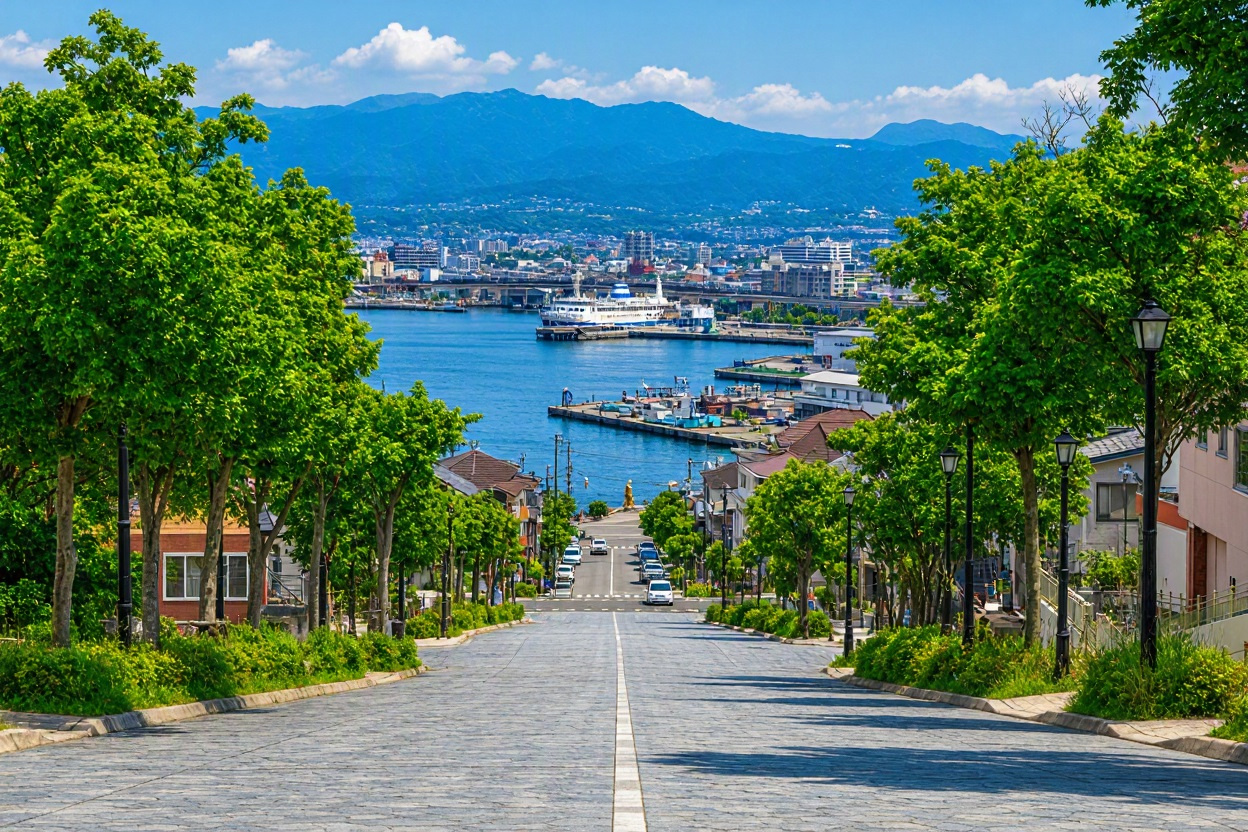
Hachiman-zaka is probably one of the most recognizable streets in Hakodate.
The road slopes downhill toward the harbor, creating a straight visual line between the city and the water.
Stand near the top and look down.
You get the road, trees, old buildings, and sea in one frame.
It is beautiful in every season, but the feeling changes with the weather.
On a clear summer day, the harbor looks bright and blue.
In autumn, the trees add warm colors.
In winter, snow can cover the road and make the scene feel much quieter.
There is a practical side to this famous view too.
The slope can become extremely slippery in winter.
More on that later, because it is one of the most important real-life tips I can give first-time visitors.
Trappistine Convent — A Quiet Side of Hakodate
The Trappistine Convent is a good choice when you want a break from busy sightseeing.
Founded in 1898, it is Japan’s first women’s Trappist convent. The present church building dates from 1927 and features Gothic and Romanesque influences. Visitors can enjoy the front garden, museum, and shop, while the convent itself remains a private religious space.
The atmosphere changes as soon as you arrive.
The city feels far away.
There are trees, brick buildings, quiet paths, and much less noise.
The shop is also worth a look. The convent is known for sweets such as Madalena cakes.
Don’t expect a large attraction with dozens of things to do.
That is not the point.
Come here when you want an hour or two of quiet.
The site is also a useful reminder that Hakodate is not only about seafood and night views. There is a softer, more reflective side to the city.
Yunokawa Onsen — End the Day in Hot Water
After walking up and down Hakodate’s hills, Yunokawa Onsen can feel like a reward.
The hot spring area is close to central Hakodate and Hakodate Airport, making it especially convenient for international travelers.
You can stay in a traditional Japanese ryokan, enjoy a hot bath, put on a yukata, and have dinner without needing to go back into the busy center of town.
In autumn and winter, the contrast is wonderful.
Cold air outside.
Warm water inside.
Steam rising around you.
Your shoulders finally relax.
That is one of my favorite ways to finish a Hakodate day.
If you are planning a first visit, don’t think of Yunokawa as just another hotel district. It can be part of the actual Hakodate experience.
Read more: Yunokawa Onsen Guide
Getting Around Hakodate
The Streetcar Is Your Friend
For first-time visitors, the Hakodate streetcar is one of the easiest ways to understand the city.
It connects important sightseeing areas, including the Hakodate Station area, the bay, Motomachi, and Goryokaku.
And there is something fun about it.
You are not sitting underground.
You are watching Hakodate move past your window.
Old buildings.
Shops.
People walking to work.
Snow in winter.
Green trees in summer.
It feels like part of the city rather than just transportation.
For current travel, commonly used Japanese transportation IC cards such as Suica, PASMO, Kitaca, ICOCA, and others covered by the nationwide system can be used on Hakodate trams and Hakodate buses. Hakodate’s own ICAS nimoca is also accepted.
When using an IC card on the tram, touch the reader when boarding and touch it again when leaving. You do not need to take a numbered ticket when using an accepted IC card.
There are also day passes and combined tram-and-bus passes, so check the current fares and conditions if you expect to ride several times in one day. Pass prices and products can change.
A Simple Sightseeing Flow
If you want a simple route, think of Hakodate in zones.
Morning: Hakodate Morning Market and Hakodate Station.
Late morning: Kanemori Red Brick Warehouses and the bay.
Afternoon: Motomachi, the churches, and Hachiman-zaka.
Evening: Mount Hakodate if the weather is good.
Night: Yunokawa Onsen.
Another day can be used for Goryokaku, the Trappistine Convent, and other areas outside the central waterfront.
You don’t need to force every attraction into a single day.

From Tokyo to Hakodate
The Hokkaido Shinkansen connects Tokyo with Shin-Hakodate-Hokuto. The fastest scheduled Tokyo–Shin-Hakodate-Hokuto journey is currently listed at 3 hours 57 minutes. From Shin-Hakodate-Hokuto, the Hakodate Liner connects with Hakodate Station in as little as 15 minutes, with travel times generally listed at 15–22 minutes.
That means you can build Hakodate into a larger rail trip around Japan without flying.
If you are already in Tokyo and enjoy train travel, it is a very straightforward option.
Flying to Hakodate Airport is another practical choice, especially if you are coming from another Japanese city or want to save time.
From Sapporo
The limited express Hokuto connects Sapporo and Hakodate. JR Hokkaido currently lists all seats on its limited express trains as reserved, so check the current train and reservation details before traveling.
Once you arrive in Hakodate, you can switch to the streetcar, bus, taxi, or walk depending on your destination.
Best Seasons to Experience Hakodate
Spring — Goryokaku Turns Pink
Spring is one of the most exciting times to see Hakodate.
Goryokaku Park has around 1,500 cherry trees, and when they bloom, the star-shaped fortress becomes surrounded by pink. You can see the flowers from ground level or from Goryokaku Tower.
The weather can still feel chilly.
In 2026, Hakodate’s official cherry blossom opening was announced on April 18, with full bloom around April 20–21 depending on the source and forecast. Dates change every year, so use current forecasts rather than copying a date from an old travel guide.
Bring a jacket.
Seriously.
You can be surrounded by beautiful pink blossoms while your hands are still cold.
Summer — Hakodate Gets Loud and Lively
Summer brings green trees, longer days, outdoor walks, and festivals.
The Hakodate Port Festival is the city’s major summer festival, filling the city with events and performances. The 2026 festival was scheduled for August 1–5.
This is a great season for walking around the bay and Motomachi.
The downside?
Crowds and heat.
You may also find that a sea breeze makes evenings cooler than expected, so carrying a thin jacket is still useful.
Autumn — Eat, Walk, Repeat
Autumn is a very comfortable time to explore Hakodate.
The air gets cooler, the crowds can feel easier to handle, and seasonal food becomes a big part of the trip.
This is when I like taking long walks through Motomachi, visiting Goryokaku, eating seafood, and heading to the waterfront when the afternoon light gets softer.
The smell of the sea mixes with cool air.
Leaves change color.
You start thinking about hot springs.
It feels like Hokkaido.
Winter — Snow and Christmas Lights
Winter gives Hakodate a completely different personality.
Snow can cover the streets and hills, and the cold air makes hot food and hot springs feel even better.
The Kanemori Red Brick Warehouses host Hakodate Christmas Fantasy, centered around a giant Christmas tree floating in the bay. The event includes evening fireworks and special lighting, creating a bright scene against the cold winter waterfront.
For 2026, the event is scheduled for December 1–25.
The winter sea breeze can be brutal, though.
Wear proper shoes and warm layers.
You will thank yourself later.
Local Tips for First-Time Visitors
Real Tip #1: Winter Hills Are Much More Slippery Than They Look
This is the kind of thing that photographs never show you.
Hachiman-zaka can look like a simple walk downhill.
After snow or freezing temperatures, it can become a sheet of ice.
The same applies to other sloped streets around Motomachi.
Do not wear smooth-soled fashion sneakers just because they looked fine when you left your hotel.
If you visit in winter, wear shoes with good grip. Walk slowly, keep your hands free when possible, and don’t stare at your phone while going downhill.
It sounds obvious.
Then you see someone nearly fall.
Don’t be that person.
Real Tip #2: Learn the Streetcar Payment Routine Before Boarding
Hakodate’s streetcars are easy once you understand the system, but the first ride can feel confusing.
With an accepted IC card, touch the reader when you board and again when you get off.
With cash, take a numbered ticket when required, check the fare board, and prepare the exact fare. The fare box itself does not make change, although a change machine is available. Hakodate City notes that the change machine has a ¥2,000 limit.
If you have a Suica, PASMO, ICOCA, or another accepted card, using it can make the ride much simpler.
One important detail for mobile IC users: Hakodate’s official guidance warns that certain mobile IC cards should not be tapped against the vehicle reader when using some digital tickets. Keep your digital ticket and IC payment method separate and follow the instructions shown for the ticket you purchased.
Real Tip #3: Don’t Assume Every Bus Runs Late
Hakodate is not Tokyo.
Some routes have limited service, especially outside the busiest areas.
Before heading somewhere such as the Trappistine Convent, check your return route too.
You don’t want to arrive at a beautiful sightseeing spot and then discover that your next bus is much later than expected.
Take a screenshot of your return timetable.
That tiny habit can save a lot of stress.
Real Tip #4: Mount Hakodate Weather Can Ruin the View
A clear blue sky in central Hakodate does not automatically mean perfect conditions at the summit.
Cloud, wind, and visibility can change the experience.
Check the conditions before you go.
If the view is completely blocked, don’t waste your entire evening waiting in the cold. Change your plan and try again another time if your schedule allows.
Real Tip #5: Wear Comfortable Shoes
This sounds boring.
It isn’t.
Hakodate sightseeing involves walking up slopes, down slopes, across waterfront areas, through parks, and between tram stops.
You can easily walk much farther than you planned.
Good shoes will make the difference between “Let’s keep exploring” and “My feet hurt, let’s go back to the hotel.”
FAQ
How do I get to Hakodate from Tokyo?
The Hokkaido Shinkansen runs from Tokyo to Shin-Hakodate-Hokuto. From there, the Hakodate Liner connects with Hakodate Station, with the current fastest connection taking about 15 minutes after the Shinkansen journey.
Flying to Hakodate Airport is another option, especially when your Japan itinerary already includes domestic flights.
Can I use Suica on Hakodate’s streetcars?
Yes. Suica, PASMO, Kitaca, ICOCA, and other cards covered by Japan’s nationwide transportation IC system can be used on Hakodate trams and Hakodate buses. Hakodate’s ICAS nimoca is also accepted.
On the tram, touch your card when boarding and again when getting off.
If you are using a mobile ticket rather than paying with an IC card, check the instructions for that specific ticket because the two systems should not be confused.
How many days should I spend in Hakodate?
For a first visit, 2 to 3 full days is a comfortable starting point.
Two days can cover the major city sights, including Goryokaku, the Morning Market, bay area, Motomachi, Hachiman-zaka, and Mount Hakodate.
Three days gives you more time for Yunokawa Onsen, the Trappistine Convent, slower meals, shopping, cafes, and weather flexibility.
If you want to explore more of Southern Hokkaido, use Hakodate as your base for a longer trip.
Summary
Hakodate is a city that rewards you for slowing down.
Start with seafood at the morning market.
Look down on Goryokaku from above.
Ride a streetcar through the city.
Walk the slopes of Motomachi.
Stand at the top of Hachiman-zaka and look toward the harbor.
Spend time around the red brick warehouses.
Wait for the lights of Hakodate to appear from Mount Hakodate.
Then finish the day in warm water at Yunokawa Onsen.
What I love most is how naturally all these experiences fit together.
You can see Japanese history at Goryokaku, international history around Motomachi, local life on the streetcar, the fishing culture of the market, and the sea from almost everywhere.
In winter, the city becomes quieter and colder.
In spring, Goryokaku turns pink.
In summer, the streets fill with festival energy.
In autumn, the air becomes crisp and the food gets even more tempting.
You don’t need to race through Hakodate.
Leave time for a second coffee.
Stay at the waterfront after sunset.
Walk one extra street.
Eat something you have never tried.
And if the weather changes your plan, let it.
That is part of traveling here.
Hakodate is more than a famous night view.
It is a port city you can taste, hear, walk, and feel.
Once you have explored the city properly, you will also have an easy starting point for the wider Southern Hokkaido region.
That is where the next adventure begins.
Featured image photo credit: Generated by AI
Leave a Reply